When the Website Starts Talking Back: The Next Chapter of Online Business
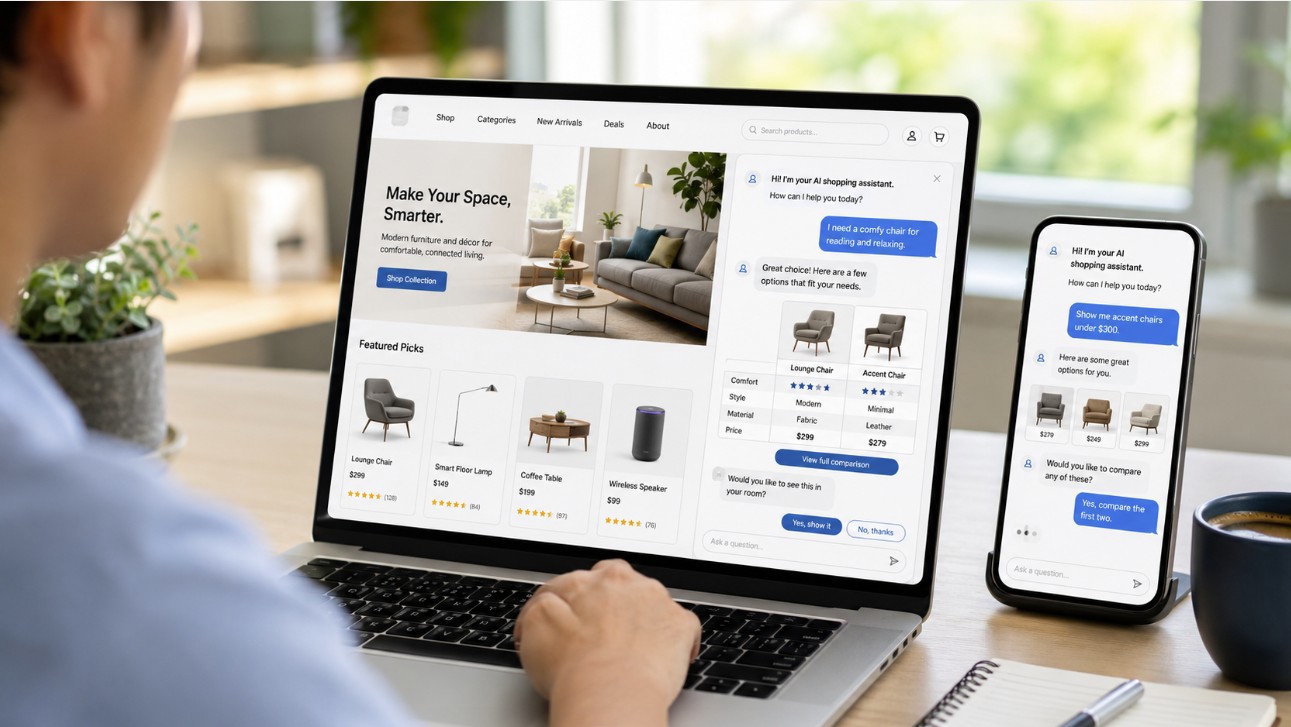
Imagine opening a company website in 2028. There is still a logo, a menu and several attractive photographs. But instead of searching through twelve pages, opening three tabs and hunting for the delivery policy, you simply say: “I need a reliable laptop for travelling, video calls and light design work. My budget is €1,200. What would you recommend?”
The website asks two sensible questions, compares several models, explains the trade-offs and checks what is currently available. It may offer a bundle, apply an eligible discount and prepare the order. You are no longer navigating the website. The website is navigating the decision with you.
This is likely to be one of the most important changes in online business over the next several years. Websites will not disappear, but their role will change. They will evolve from collections of pages into intelligent business environments where customers can research, compare, ask, negotiate, book, buy and receive support through one continuous conversation.
The Website After the Search Bar
For years, websites have quietly assigned work to their visitors. Choose a category. Set the filters. Read the descriptions. Compare the specifications. Find the FAQ. Locate the return policy. Try to remember which product was in the first tab.
A good AI communication service reverses this arrangement. The customer explains the goal, while the system does much of the searching, sorting and comparing. Modern conversational agents can already work with product catalogues, availability data, order histories and customer-service systems. They can recommend products, update shopping carts, initiate returns, manage subscriptions and guide customers through checkout.
The old chatbot said, “Here is a link to our returns page.” The new agent says, “I found your order. The blue jacket can be returned until Friday. Would you like a refund or shall I help you exchange it for another size?” Do you see the difference? What you get is a completed business process.
Will People Buy More Through Websites?
Probably, but not simply because AI makes websites fashionable. People will buy more when AI removes uncertainty at the exact moment when uncertainty normally kills a purchase. Similarweb estimated that visitors reaching ecommerce websites from ChatGPT converted at 11.4%, compared with 5.3% for visitors arriving through organic search. These AI-referred customers may be fewer in number today, but they frequently arrive after already researching and narrowing their options.
McKinsey reports that 38% of surveyed consumers in France, Germany and the UK already use AI when researching products or deciding what to buy. Among these shoppers, 63% use it to compare brands, models, prices and reviews. This suggests that the buying journey is changing before the customer even reaches the website. A future visitor may arrive accompanied by a personal AI assistant that already knows the budget, preferences, previous purchases and delivery requirements. The customer’s agent may then communicate with the company’s website agent: “My user needs a family hotel in Rome, close to public transport, with breakfast and free cancellation.”
The website agent checks availability, explains the best options and prepares the booking. The human remains in control, but much of the exhausting digital tourism happens between the two systems.
VML found that 48% of consumers are excited by the idea of their AI communicating with a retailer’s AI to obtain the right products. Apparently, even robots may soon be asked to “have a quick call.”
More Communication, but Fewer Separate Conversations
Website-hosted communication will probably increase. However, it will become less isolated. A conversation may begin on a website, continue through WhatsApp, move to email and finish through voice, without forcing the customer to repeat the same story four times. The agent will remember that the visitor was comparing two insurance plans, asking about a delayed delivery or considering a software subscription. It will maintain context across channels and call a human employee when judgment, empathy or special approval is required.
This human handover will be essential. Customers appreciate speed, but they do not want to be imprisoned inside an endlessly cheerful machine. Large-scale production evidence is encouraging. In customer-support deployments at Nubank, serving more than 100 million users, improved AI agents increased transactional Net Promoter Score by 37 percentage points and self-service rates by 29 percentage points in one card-delivery use case. Customer satisfaction in several use cases approached the level achieved by expert human agents.
The lesson is not that humans are becoming unnecessary. It is that humans should receive the difficult conversations, while AI handles routine work quickly and consistently.
The Website Becomes an Employee
The strongest websites of the next decade will not simply display information. They will represent the company. They will know the products, policies, availability and customer history. They will recognize buying signals, answer questions, complete actions and learn which obstacles repeatedly prevent purchases.
McKinsey reports that some leading retailers already see conversion rates above 50% through on-site AI bots, while AI customer-service copilots can reduce handling time by 40–60%. Yet success will depend on more than adding a chat window. An effective website agent must have accurate business knowledge, access to real systems, clearly defined permissions, security controls and a reliable path to human support. A badly connected agent will simply produce faster confusion. The website of the future will therefore be part salesperson, part consultant, part customer-support specialist and part digital concierge. It will meet them, talk to them and help them move from curiosity to decision.
For companies, that means the website is no longer merely where business information lives. It is where business begins to act.