When AI Agents Start Talking to Each Other: The Rise of Autonomous Digital Teams
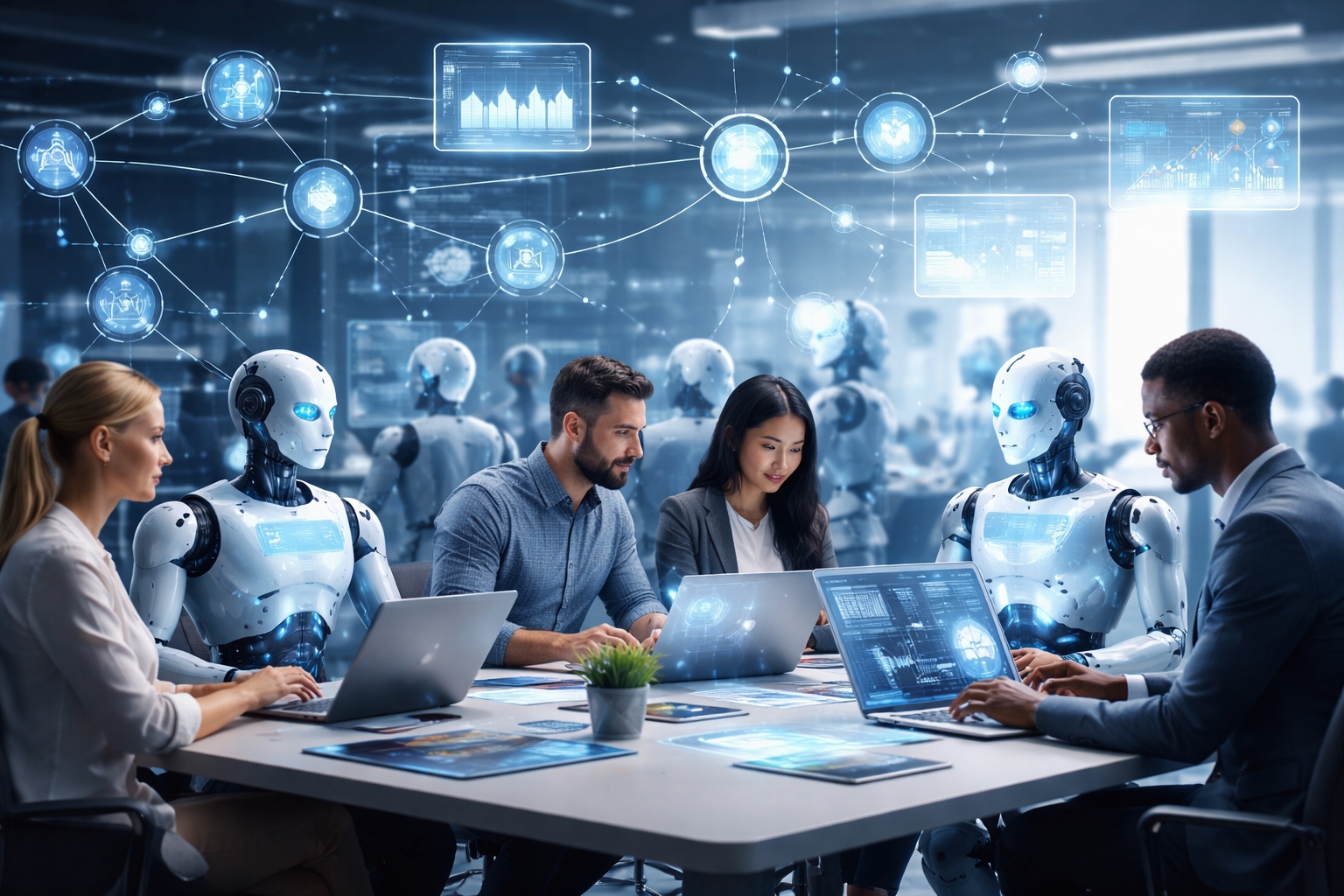
Over the past two years, something remarkable has started happening inside modern companies. AI systems have been increasingly changing and turning from smart tools into our real teammates. Companies across industries are introducing AI agents that work alongside people, helping analyze data, generate reports, write code, coordinate workflows, and even make operational recommendations. The result is the emergence of hybrid teams, where humans and AI collaborate as part of the same operational structure.
Recent research shows how quickly this shift is happening. Surveys indicate that more than 80% of business leaders expect to expand the use of AI-powered “digital workers” within the next 12–18 months. In many companies, these systems are already delivering measurable results: businesses that started using structured human-AI collaboration frameworks report productivity increases of around 30% compared with traditional human-only teams.
At the same time, employees themselves appear ready for the change. In a global survey, 84% of professionals said they are interested in working alongside AI agents, expecting improvements in efficiency and work quality.
Which Companies Are “Employing” AI Agents?
Some well-known companies are moving especially fast. One striking example comes from McKinsey & Company, which has integrated approximately 25,000 AI agents into its operations alongside about 40,000 human employees. These agents assist consultants with research, data analysis, modeling, and internal knowledge search. According to company leadership, they have already saved around 1.5 million hours of human work.
Logistics giant FedEx is also building an “AI agent workforce.” The company plans to embed AI across more than half of its operational processes in the coming years. These agents support tasks such as network planning, customs processing, and operational analytics while coordinating with human teams through layered “manager” and “audit” agents.
Across industries, from consulting to logistics to marketing, companies are discovering that the biggest gains do not come from replacing people, but from redesigning workflows so that humans and AI complement each other.
Benefits... and Some New Challenges
Today, the advantages of hybrid teams are clear to everyone:
• faster data analysis
• automation of routine work
• continuous operation (AI does not sleep)
• faster experimentation and decision cycles
The so-called "hybrid" Human-AI teams also tend to shift people toward more creative and strategic work. Studies show that when AI assists with repetitive tasks, humans can spend significantly more time focusing on higher-value activities.
But there are drawbacks as well. Introducing AI into a team often amplifies existing organizational problems. If processes are poorly structured, AI simply accelerates the chaos. Researchers also warn about cognitive overload when workers must manage too many AI tools simultaneously, a phenomenon sometimes called “AI brain fry.”
This is why management suddenly becomes a critical factor. Leading a hybrid team requires new skills: defining boundaries for AI autonomy, validating outputs, maintaining accountability, and ensuring that human judgment remains part of key decisions.
The Next Stage: AI Agents Managing Other Agents?
But the evolution doesn’t stop with hybrid teams. A new operational model is already emerging: autonomous groups of AI agents that collaborate with each other, while humans supervise the system rather than perform the work directly. In these architectures, different agents specialize in different roles. One agent might collect data, another analyze it, a third generate recommendations, and a fourth verify results before escalating decisions to a human manager.
This type of multi-agent collaboration is gaining attention because it allows organizations to orchestrate complex workflows automatically. Early studies show that groups of interacting agents can produce more diverse ideas and faster problem-solving than single-agent systems.
However, these systems still require human oversight. Reliability, governance, and accountability remain major challenges for production-grade AI agents today.
The Emerging Role of the “AI Team Manager”
As AI adoption accelerates, a new organizational role is quietly emerging: the manager of AI agents. Instead of managing people performing tasks, leaders increasingly coordinate networks of AI systems that execute them. Humans define goals, set policies, monitor outcomes, and intervene when necessary.
In other words, the future workplace may look less like traditional teams—and more like human leaders directing entire ecosystems of digital collaborators. And if the current trend continues, the most valuable skill in the next generation of business may not be writing code or running spreadsheets. It may simply be knowing how to lead teams that include both humans and intelligent machines.