From AI Assistants to AI Teams: How Agents Are Learning to Work Together
A few months ago, I was speaking with a project team lead who had just introduced a set of AI agents into his product team. At first, he described it as a small experiment. One agent was helping with research, another with writing code, a third one reviewing results. Nothing too ambitious. But then he paused and said something interesting: “They’ve started coordinating with each other.” That was the moment when the conversation shifted. What he was observing was not just automation. It was the early shape of a system where AI doesn’t simply assist people, but begins to organize work on its own.
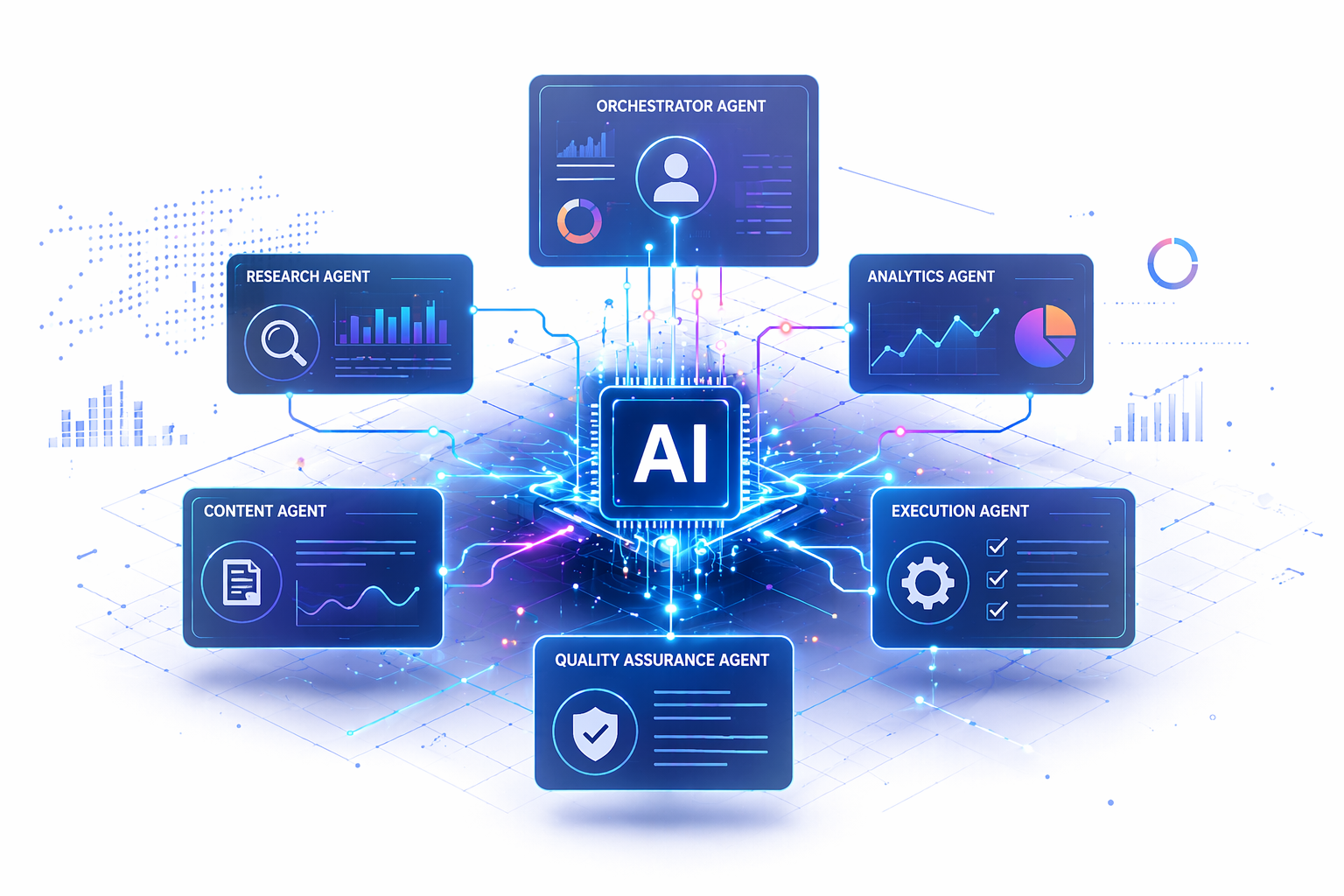
This is where agentic technologies are quietly taking us. We are moving away from single AI tools toward groups of agents that behave more like teams. One agent defines the goal, another breaks it into steps, several others execute those steps, and somewhere above them sits a coordinating agent that keeps everything aligned. If this sounds familiar, it is because it mirrors how we have always structured human work. The difference is that now this structure can exist inside software.
I have seen this pattern emerging across industries. In software development, for example, companies are experimenting with AI systems that can take a feature request and move it through an entire cycle. One agent explores possible solutions, another writes the code, another tests it, and yet another monitors the outcome and suggests improvements. It is not perfect, far from it, but it already changes the rhythm of delivery. What used to require constant coordination between developers, QA engineers, and team leads can now happen within a semi-autonomous loop.
In logistics and operations, the same idea is appearing in a different form. Imagine a network where one agent predicts demand, another allocates resources, and a third reacts to disruptions in real time. Instead of a static system, you get something that continuously adjusts itself. In customer service, agents receive requests, classify them, retrieve the right information, and respond, often before a human even notices the request has arrived. Marketing teams are also experimenting with this structure, where entire campaigns are run by groups of agents that research topics, generate content, distribute it, and measure performance.
But if you ask whether these “AI teams” already work flawlessly, the honest answer is no. Sometimes they produce results that feel almost magical, especially when the task is structured and well-defined. And sometimes they get stuck, loop through the same steps, or confidently produce something that simply does not make sense. Coordination between agents, which looks elegant in theory, can become messy in practice. Without clear control, the system can drift. This is why the idea of a “supervising agent” or a control layer is becoming so important. Someone, or something, needs to watch the watchers.
This is also where people remain essential. In fact, the role of humans becomes more interesting, not less. Instead of doing every step themselves, people begin to design the system in which the work happens. They define goals, set constraints, decide how agents interact, and step in when judgment is required. It is less about execution and more about orchestration. In a way, it feels similar to managing a highly capable team where everyone works very fast and sometimes a bit unpredictably.
There are clear benefits. Companies can move faster without proportionally increasing their headcount. Routine work becomes lighter. Iteration cycles shorten. But there are also new questions that businesses are still learning to answer. How much do you trust the system? Who is responsible for the outcome when agents make decisions? What skills do your teams need when the work shifts from doing to supervising? These are not technical questions alone; they are organizational ones.
What I find most interesting is where this is all heading. We are beginning to see software that behaves less like a tool and more like an organization. Not a perfect one, not yet, but one that can take initiative, distribute tasks, and adapt over time. In the next few years, this will likely become a standard layer inside many businesses. Not something experimental, but something expected.
And this changes the way we think about growth. The constraint is no longer just how many people you can hire or how fast you can build a team. It becomes how well you can design and manage these hybrid systems where people and AI agents work side by side. The companies that learn to do this early will not just move faster. They will operate differently.
So when we talk about AI today, it is less useful to think in terms of tools and features. A more relevant question is starting to emerge. Not whether a company uses AI, but how effectively it can structure and guide its own digital workforce.