Your Business Already Has the Data. The New Question Is: Can Your People Actually Use It?
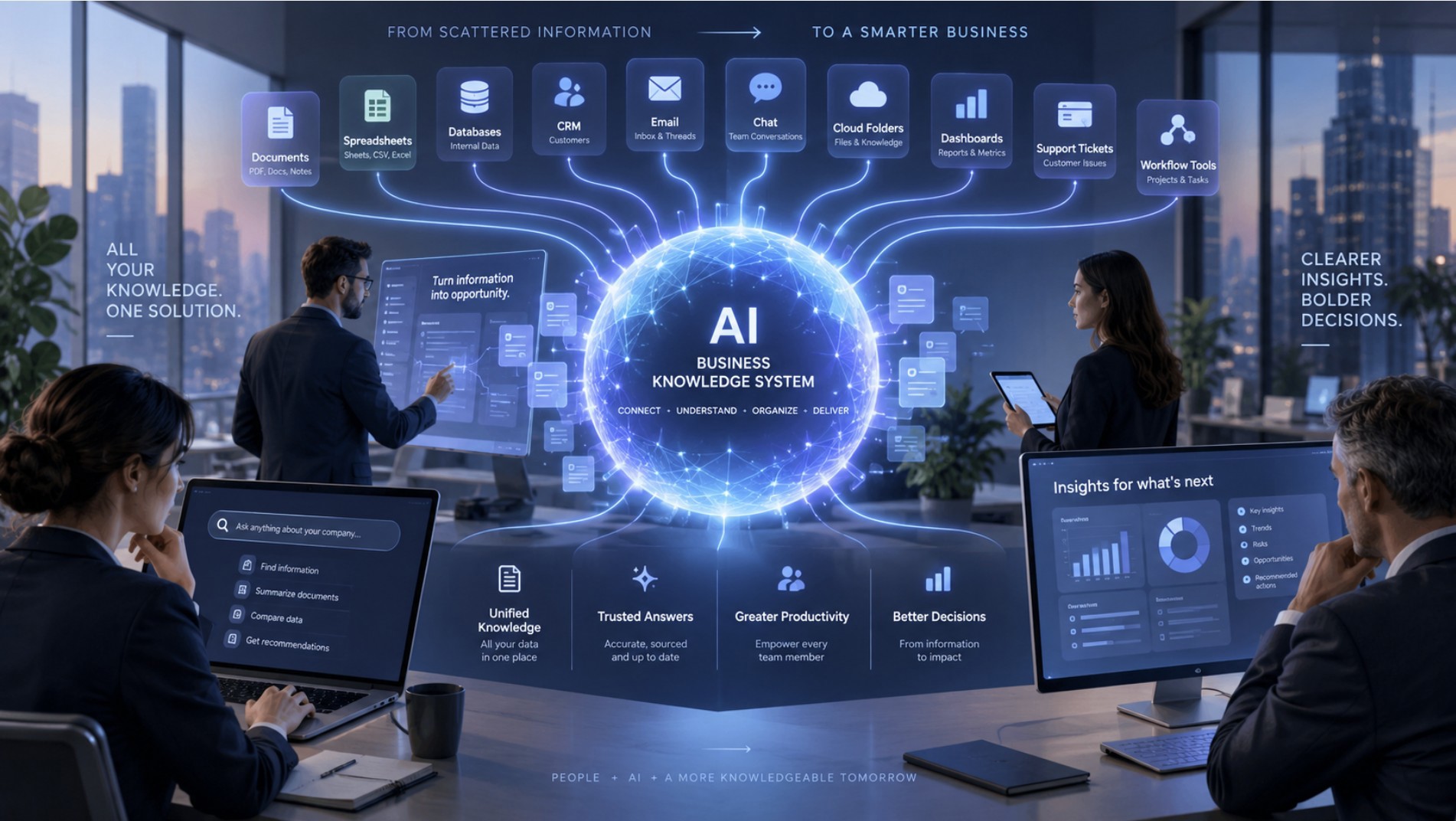
Most companies do not have an information shortage, they have the opposite problem: customer information sits in the CRM, contracts are stored in SharePoint or Google Drive, while product information lives in spreadsheets and databases, project decisions disappear into Teams, Slack, Jira, or email, procedures are stored somewhere in a knowledge base, and some of the most important operational knowledge still lives in the heads of individual employees. For years, companies tried to solve this by moving everything into a single system. In 2026, a different approach is becoming much more practical.
Instead of relocating all corporate information, modern AI platforms can connect to the systems a company already uses, understand the information stored there, preserve existing access permissions, and give employees a conversational interface for finding information, analyzing it, and increasingly taking action.
The result can look remarkably simple:
“Which customers have open support issues and contracts renewing this quarter?”
“What did we promise this customer during the last three meetings?”
“Find our latest pricing policy for Germany.”
“Compare these three suppliers and summarize the risks.”
“Prepare an onboarding package for our new sales manager.”
The AI searches across the appropriate company sources, assembles the context, and returns an answer, often with citations back to the original information. And increasingly, it can do something with that information rather than simply find it. That change has produced several different classes of platforms.
Four types of business AI platforms are emerging
It is tempting to put all of these products into one category, but that would be misleading. In 2026, the market can roughly be divided into four groups.
1. Enterprise search and company-context platforms
Products such as Glean (Glean official platform page) and Coveo (Coveo workplace solutions) specialize in connecting many corporate information sources and creating a searchable intelligence layer over them. The important word here is layer. The company does not necessarily move its Salesforce records, SharePoint files, Jira tickets, support documents, and other information into a completely new operational system. Instead, the platform indexes or connects to those systems and makes their information accessible through unified search and AI.
Glean (Glean official platform page) combines connectors, enterprise search, an Enterprise Graph and AI agents. Its integrations can also do more than retrieve information: for example, its Salesforce connector can access accounts, contacts, opportunities and leads and execute selected actions such as creating or updating records.
Coveo (Coveo connector directory) takes a particularly connector-heavy approach. Its platform can index structured and unstructured information from systems including Google Drive, SharePoint, databases, Jira, Salesforce, ServiceNow and many others while retaining source permissions. Native connectors can often be configured through an administrative interface, while custom repositories may require API or developer work.
These platforms are powerful, particularly for organizations with many existing enterprise systems. But they are generally closer to an enterprise implementation project than to “sign up this morning and let everybody use it this afternoon.”
2. AI knowledge workspaces
A second category combines company knowledge, documents and everyday work inside one workspace. Notion AI (Notion Enterprise Search) is a good example. Its Enterprise Search can search the company's Notion workspace together with connected applications such as Slack, Google Drive, GitHub, Jira, Microsoft Teams, SharePoint and OneDrive. Answers include citations to the underlying sources.
The interesting development in 2026 is that Notion (Notion AI and agents) is no longer simply a wiki with AI attached to it. Its Business plan includes Notion Agent, AI Meeting Notes and Enterprise Search, while Custom Agents can perform multi-step work on schedules or triggers. For smaller and midsize companies, this approach has an obvious advantage: documents, projects, databases, search, meeting notes and AI can live in one relatively easy-to-manage environment. The trade-off is that the model works best when a significant share of company knowledge is already in Notion (Notion pricing and plans) or in applications for which good connectors exist.
Another product in this category is Guru (Guru AI enterprise search).
Its focus is particularly interesting: rather than merely finding information, Guru (Guru knowledge platform) emphasizes maintaining a trusted knowledge layer. It connects sources such as Drive, SharePoint, Slack, Zendesk, Confluence and CRM systems, preserves permissions, provides cited answers and identifies stale or missing knowledge.
That makes this category especially useful for organizations where the main pain is not transaction processing but questions such as:
-
Where is the latest version of this policy?
-
Which procedure should this employee follow?
-
What is the approved product description?
-
Which answer should support agents give customers?
-
Is this information still valid?
In other words, these systems increasingly act as a corporate memory layer.
3. Ecosystem-native copilots
Another approach is extremely attractive for companies already living inside Microsoft or Google. Instead of adding a completely separate knowledge platform, businesses can extend the ecosystem they already use. Microsoft 365 Copilot Microsoft 365 Copilot business pricing uses Microsoft's Work IQ and Microsoft 365 context, but it can also connect external business information through Copilot connectors. Microsoft now documents more than 100 prebuilt connectors from Microsoft and partners, including connections to Salesforce, ServiceNow, Box, Google services and other systems.
There are two important connection models in Microsoft 365 Copilot Microsoft Copilot connectors documentation:
-
synced connectors, which index external information into Microsoft Graph;
-
federated connectors, which access external systems at query time without copying the information into the Microsoft index.
Both respect access permissions, and external content can appear directly in Copilot responses. For companies already running Microsoft 365, this can considerably lower the organizational barrier to AI adoption. Employees do not have to learn an entirely separate environment. However, connecting external enterprise systems still requires administration. Microsoft states that deploying Copilot connectors requires appropriate administrator permissions and source credentials, although many prebuilt connectors use optimized default configurations.
Gemini Enterprise Google Gemini Enterprise official page follows a similar philosophy but is deliberately ecosystem-neutral.
Google says its Business edition can connect not only to Google Workspace but also to Microsoft 365, HubSpot, Jira and other business systems. It includes enterprise search, AI-generated analysis, no-code agent creation and workflow automation. The Business version is explicitly positioned as requiring no IT setup. Supported connectors currently include Box, Confluence, Dropbox, GitHub, Google Drive, Gmail, HubSpot, Jira, Microsoft Outlook, Teams, OneDrive, SharePoint, ServiceNow, Slack and others.
This makes Gemini Enterprise Gemini Enterprise Business edition particularly interesting for a smaller company that has accumulated information across several SaaS systems but does not want to build its own AI infrastructure.
Users can search and analyze company information, create content, build custom agents with a no-code Workflow Builder and automate multi-application workflows.
4. Agent and workflow platforms
The fourth category moves beyond information retrieval toward actual work execution.
IBM watsonx Orchestrate IBM watsonx Orchestrate pricing and plans is one example.
Rather than concentrating primarily on a company wiki or search box, it focuses on building and orchestrating AI agents that connect systems, process documents and execute workflows.
IBM's Essentials plan includes agent building and orchestration, workflow and document processing, an agents/tools catalog, custom tool creation, core AI models and access controls.
This is more appropriate when the requirement evolves from:
“Find the information for me”
to:
“Find the information, evaluate it, update the relevant system and start the next step of the process.”
That additional power usually comes with additional configuration and governance requirements.
A lighter variation of the agent model is BizDriver.ai (BizDriver.ai official website).
Rather than asking a business to create an entirely new knowledge architecture, BizDriver.ai (BizDriver.ai feature overview) can automatically ingest information from a business website and uploaded documents, work with structured CSV data, and connect to backend systems through Model Context Protocol integrations.
Its public deployment model is deliberately lightweight. A company can provide its website URL, allow the system to configure the agent automatically, optionally upload additional files and add the resulting agent to its website using a JavaScript snippet. The company's integration guide describes a basic website installation as approximately a two-minute process.
For more advanced applications, BizDriver.ai (BizDriver.ai business integrations) can be connected to ordering, billing, CRM or other backend systems through custom MCP-based integrations.
That puts it in a different position from large enterprise search platforms: the starting point can be a specific business use case—customer assistance, product information, lead qualification or access to selected business data—rather than an enterprise-wide knowledge transformation project.
What does all this cost?
Pricing is surprisingly difficult to compare because these platforms use very different models. Some charge for every employee.
Some charge by platform capacity. Some charge for AI usage. Some combine subscription fees with implementation services.
And several enterprise vendors do not publish prices at all. The figures below are publicly available prices as of September 2026 and should be treated as indicative; enterprise contracts, taxes, usage and implementation work can change the actual cost substantially.
| Platform | Public starting price | How it is sold | Approximate deployment effort |
|---|---|---|---|
| BizDriver.ai Pricing | Free for 500 messages/month; Super Nova $20/month for 1,000 included messages; Enterprise: quote | Usage/platform model rather than per employee | Very low for basic website deployment; higher for backend integration |
| Notion AI Pricing | Business $20/member/month; Enterprise quote | Per user; Custom Agents use additional credits | Low–moderate |
| Gemini Enterprise Pricing and editions | Business from $21/seat/month; Standard/Plus from $30/seat/month | Per seat | Low–moderate for standard connectors |
| Microsoft 365 Copilot Business pricing | Business pricing varies by market; current Polish/EU offer starts at €15.60/user/month annually during the 2026 promotion; enterprise Microsoft 365 Copilot is €26/user/month in Microsoft's Polish pricing | Per user, generally in addition to an eligible Microsoft 365 plan | Low inside Microsoft 365; moderate when external data must be connected |
| IBM watsonx Orchestrate Pricing | Essentials from $530/month; Standard from $6,360/month | Platform/capacity model | Moderate–high |
| Guru Pricing model | Custom quote | Platform + implementation/expertise | Moderate |
| Glean Glean platform | No public standard price; sales/demo engagement | Enterprise contract | Moderate–high |
| Coveo Coveo platform and licensing structure | Contract pricing; licensing depends on platform, solution, connectors, queries/items and add-ons | Enterprise platform/consumption model | Moderate–high |
The differences become clearer when scale is considered.
At the published list price, 100 employees on Notion Business Notion pricing would represent roughly $24,000 per year before additional Custom Agent usage.
One hundred seats of Gemini Enterprise Business Gemini Enterprise pricing starting at $21 per seat would be approximately $25,200 per year.
One hundred enterprise licenses of Microsoft 365 Copilot Microsoft enterprise Copilot pricing at €26 per user per month would represent approximately €31,200 per year, before the cost of the required qualifying Microsoft 365 licenses.
By contrast, the entry-level BizDriver.ai BizDriver.ai pricing subscription is based on agent message usage rather than the number of employees, making the economics fundamentally different for focused applications.
And IBM watsonx Orchestrate IBM pricing starts at approximately $6,360 annually for Essentials, but its Standard tier begins at about $76,320 annually, reflecting a very different level of workflow and enterprise automation.
This is why comparing these products by subscription price alone can be misleading.
The hidden cost is not AI. It is information complexity.
A $20-per-user AI product can become expensive if a company needs six months of consulting to prepare its data.
A more expensive platform can deliver excellent economics if it connects existing systems cleanly and removes hundreds of hours of repetitive searching and administration.
Before buying any platform, companies should therefore ask several questions.
Where does our information actually live?
If 80% of the useful company knowledge is already in Microsoft 365, adding Microsoft 365 Copilot Microsoft 365 Copilot may be considerably simpler than implementing another enterprise knowledge system.
If the company operates heavily in Google Workspace but also has information in HubSpot, Slack, Jira and Microsoft systems, Gemini Enterprise Gemini Enterprise may be attractive precisely because of its cross-platform connectors.
If the major problem is scattered knowledge and employees constantly asking the same questions, Notion AI Notion Enterprise Search or Guru Guru Enterprise Search may solve the business problem without introducing a very heavy enterprise platform.
If hundreds of systems, permissions and repositories must be unified across a large organization, Glean Glean platform or Coveo Coveo workplace platform provide considerably deeper enterprise-search architectures.
And if the immediate goal is to expose selected business information through an intelligent assistant without launching a large IT transformation, a lighter agent platform such as BizDriver.ai BizDriver.ai represents another route.
Search is only the beginning
Perhaps the most important change in 2026 is that these platforms are rapidly moving beyond search. The first generation answered: “Where is the document?” The next generation answered: “What does the document say?” The current generation can increasingly answer: “What does all our information tell us, and what should happen next?”
And agentic systems are beginning to execute that next step. This is why connectors, APIs and protocols such as MCP are becoming as strategically important as the language model itself. The AI model can reason. But the business value comes from giving it the right context, the right permissions, the right tools and the ability to interact safely with real business systems.
A business may not need an AI department to become an AI-enabled business
This may ultimately be the most important development. Only a few years ago, creating an AI system capable of understanding company information meant assembling developers, data engineers, ML specialists, infrastructure specialists and consultants.
That is no longer always necessary. A smaller company can now start with one website, a collection of documents or a handful of SaaS systems. A midsize organization can connect its Microsoft or Google environment to CRM, project management and support platforms. A larger enterprise can build a governed intelligence layer across hundreds of information sources. The technology scales from surprisingly small beginnings, and that changes the decision businesses need to make.
In the fall of 2026, businesses tend to set the most important and useful question: “How much of our current information and operational capability can we make intelligently accessible with the least disruption, lowest complexity and fastest measurable return?” There are finally enough practical platforms on the market to make that question worth asking.