Let's Chat, But First... Give Me Your Email
I arrive at a website with a hundred questions and a fairly modest ambition: to understand what this company offers.
Perhaps I am comparing insurance policies, looking for a book, exploring a healthcare service, or deciding whether a gym suits me. The selection is enormous. Sometimes the subject is new to me. There are pages of information, and I am not yet sure which parts matter.
Then I notice a little chat window in the corner. Lovely. Someone has thought about people like me.
I click.
“Please enter your name, email address, and phone number to start chatting.”
And just like that, my motivation disappears. I lose trust and feel used. I came to ask a question; apparently, I have arrived at a recruitment drive for somebody’s mailing list.
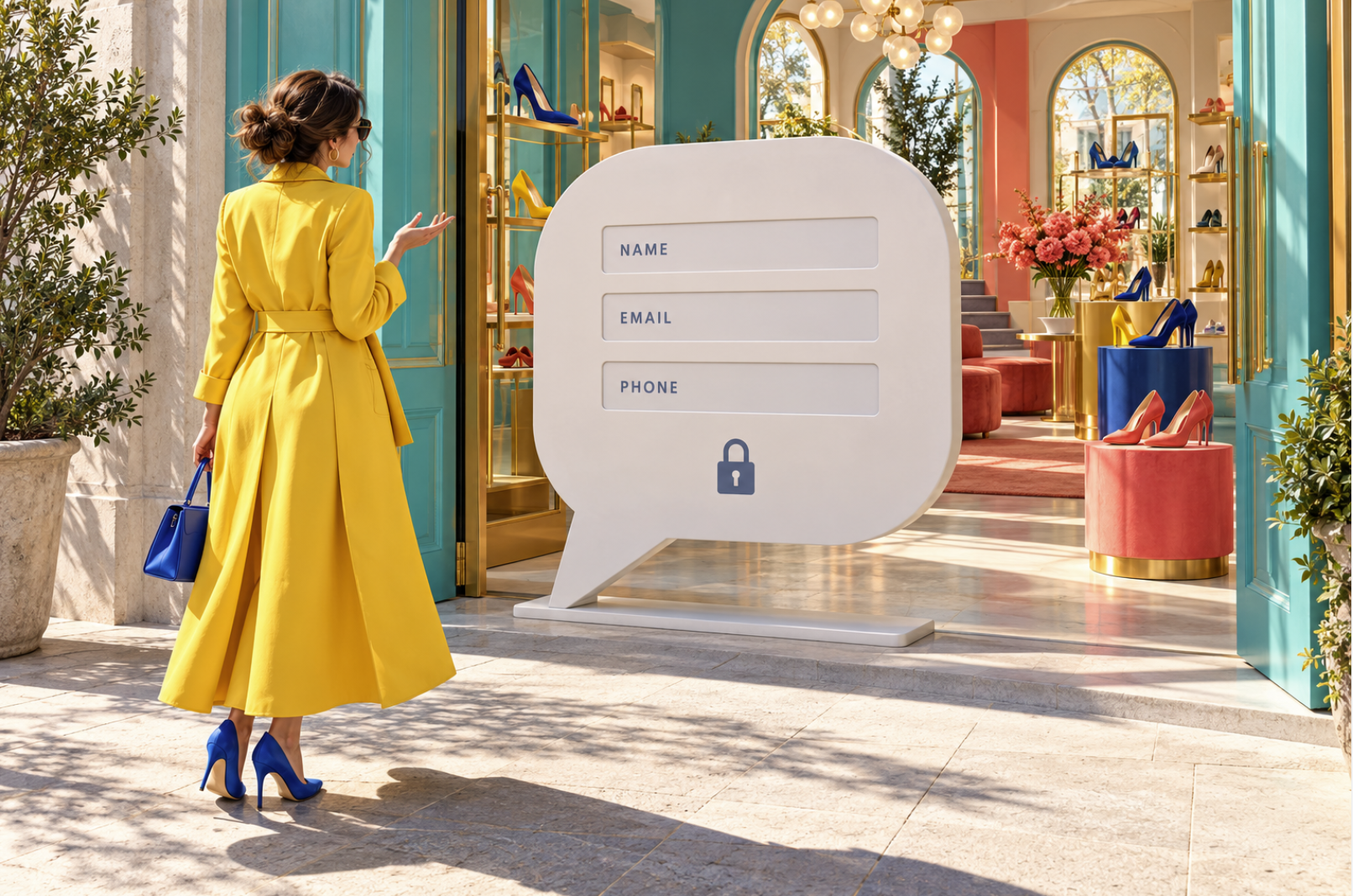
It feels like walking into a shoe store and being asked to show my ID before I can ask whether they have my size. Or entering a diner where the waiter needs my contact details before allowing me to inspect the soup.
We have barely met. Why are we already discussing a long-term relationship with my inbox?
I know an email request does not automatically mean daily marketing. But I do not know this company yet, and I have no desire to discover its enthusiasm for follow-up the hard way. Quite often, I leave the website altogether.
The cost of asking too soon
My reaction has some company in the research.
BoldChat’s 2015 Live Chat Performance Benchmarks reported an average 55% abandonment rate when visitors were presented with a pre-chat form. On mobile, the figure was 68%, compared with 52% on desktop. The report recommended limiting these forms unless they were necessary. [1]
Those are historical vendor benchmarks, not statistics about AI chats in 2026. They measure abandoned chats, rather than people leaving the whole website, and they do not prove that every departure was caused by privacy concerns. Still, they document a problem worth investigating: people can click for help and stop at the paperwork.
More recent research shows why trust deserves attention. Cisco’s 2024 Consumer Privacy Survey, covering more than 2,600 consumers in 12 countries, found that 75% said they would not buy from an organization they did not trust with their data. That is a statement of purchasing intention, not a measurement of chat behavior. But it should give anyone designing a visitor’s first interaction something to consider. [2]
Baymard’s research, updated in 2025, adds another uncomfortable detail. In a survey of 1,026 online shoppers, 14% said they would never give an online store their phone number. During usability testing, unexplained phone-number requirements prompted some people to abandon checkout or provide false details. [3]
So, a business may congratulate itself on collecting another number while its database quietly fills with 999999999. Excellent. The sales team can now call an imaginary person.
When help starts feeling uncomfortable
Chatbot research also connects privacy concerns with the quality of the experience.
A 2020 study of 1,064 US consumers found that perceived privacy risk was associated with lower chatbot satisfaction. Satisfaction, in turn, was positively associated with customer loyalty and willingness to continue using the chatbot. Convenience was the strongest predictor of satisfaction in the university’s account of the research. [4]
That sounds familiar. I open a chat because I want something easier than searching through twelve pages. Adding a form immediately makes the easy option harder.
Another study, published in 2021, asked 430 consumers to interact with a chatbot in a simulated car-insurance quote scenario. Privacy concerns increased perceived “creepiness,” which reduced loyalty, including through trust and negative emotions. [5]
“Creepy” is probably absent from most chatbot project briefs. It is also a rather expensive impression to leave with a potential customer.
Even chat providers recognize the problem
WhosOn, a live-chat provider, explicitly warns that prospective customers may hesitate to supply email addresses because they fear marketing spam. Its guidance recommends asking later in the conversation when the purpose is engagement and acknowledges that a pre-chat survey can annoy someone who simply needs a quick product answer. [6]
Convi’s AI-chat guidance also recognizes the friction: some visitors skip a pre-chat survey, while others close the widget. It recommends providing a Skip button and suggests starting with the survey disabled, collecting email during the conversation instead. [7]
These are providers’ recommendations, rather than independent conversion experiments. I nevertheless find it encouraging when the people selling chat tools say, in effect, “Perhaps let the visitor talk.”
A May 2026 article from TGLiveChat makes another useful point: many conversion figures circulating in this industry come from vendors and agencies without published methods. Its author revised numerical claims that could not be verified. [8]
We should resist decorating a sensible argument with suspiciously precise statistics. The available evidence supports testing the approach; it does not establish one universal percentage of customers who will leave.
Let me ask before you ask
Here is the experience I would welcome.
I open the chat and ask my question; The assistant explains the services, helps me compare options, and asks relevant follow-up questions about what I need. It points me to reliable information and tells me when a human should help.
If the conversation is useful, it offers: “Would you like me to email you this summary?”
Now there is a reason to share my email. I understand what I will receive, and I choose whether to receive it. I can decline and still finish the conversation. Sending that summary should not quietly become an invitation to every future marketing campaign.
Of course, if I want help with my account or an existing order, identification may be necessary. If I request a callback, a phone number makes sense. Explain the purpose when the need arises. My opening question about your services rarely requires my full biography.
The competition is one browser tab away
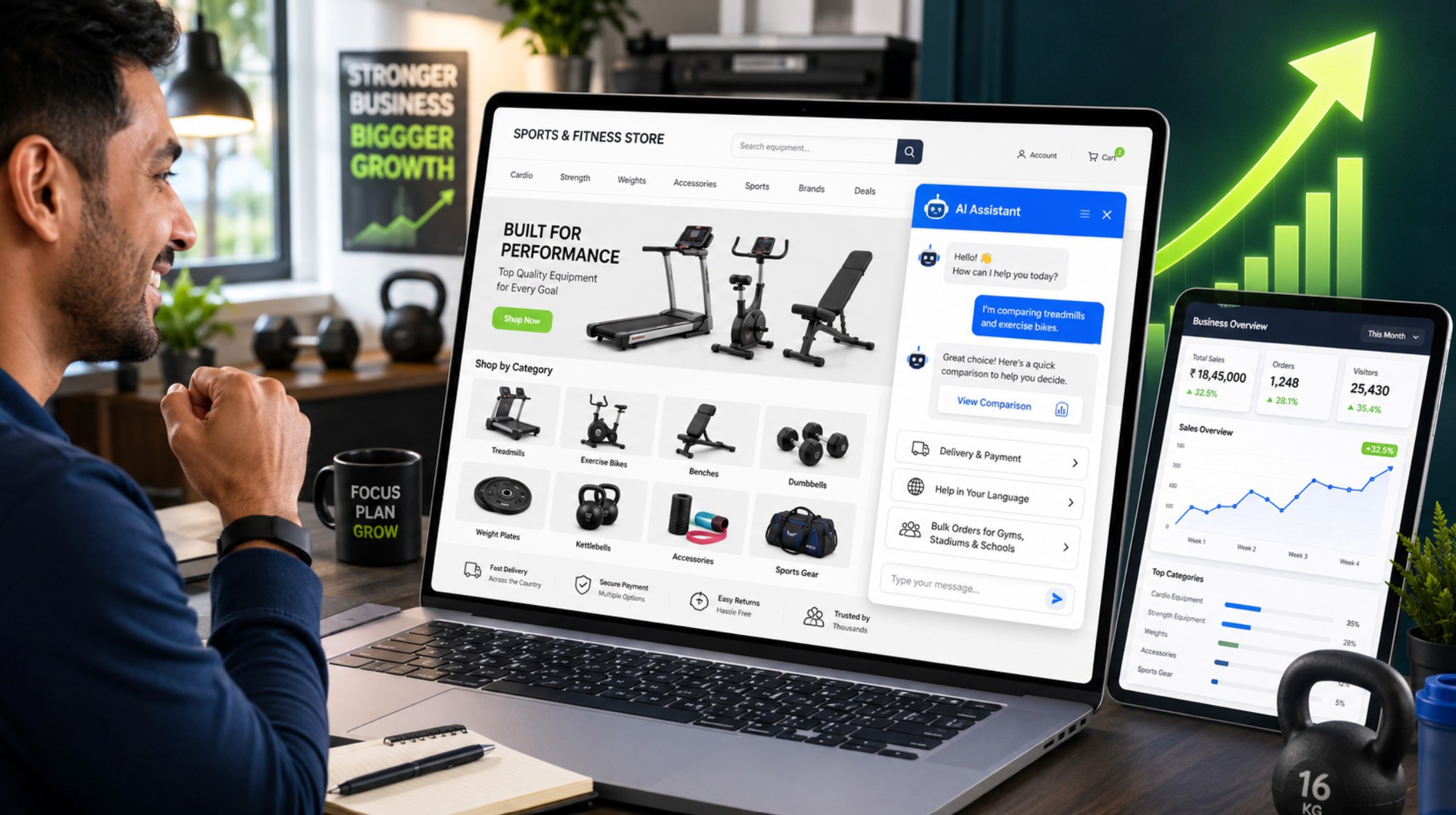
In 2026, I increasingly expect a website to help me find an answer through conversation. I still read, of course. But when I am comparing unfamiliar services, I want a response to my particular question without having to assemble it from scattered pages like, for example, they do at bizdriver.ai.
As AI assistants become more familiar, I believe that expectation will keep growing. Businesses should review whether their chat actually helps visitors explore or interrupts them to collect contact details.
I would measure useful conversations, qualified enquiries, and eventual sales alongside the number of emails captured. A contact list cannot tell you much about the people who gave up before joining it.
Help me understand your business. Give me a reason to trust you. Then offer a next step I can choose.
And please, let me see the shoes before asking for my ID.
Sources
1 BoldChat 2015 Live Chat Performance Benchmarks
2 Cisco 2024 Consumer Privacy Survey
https://www.cisco.com/c/en/us/about/trust-center/consumer-privacy-survey.html
3 Baymard Phone Number UX updated July 2025
https://baymard.com/research-articles/explain-phone-number-field
4 NC State account of Cheng and Jiang chatbot study 2020
https://news.ncsu.edu/2020/12/4-factors-users-chatbots/
5 Rajaobelina and colleagues Creepiness and chatbot loyalty 2021
https://onlinelibrary.wiley.com/doi/abs/10.1002/mar.21548
6 WhosOn Pre chat survey questions
https://www.whoson.com/live-chat-best-practice/pre-chat-survey-questions/
7 Convi Predefined inquiries and pre chat surveys
https://help.conviapp.com/en/articles/13823931-setting-up-predefined-inquiries-pre-chat-surveys
8 TGLiveChat Pre chat forms May 2026