The AI Dictionary of 2026: Why New Terms Matter More Than You Think
Lately, I have noticed something interesting: almost every day, I come across a new technical term that did not exist a year ago. Sometimes it appears in a product announcement from Anthropic. Sometimes it comes from OpenAI, Microsoft, Google, GitHub, or another AI company. Sometimes it starts as a phrase used by a well-known researcher or engineer and then suddenly spreads across thousands of discussions, articles, conference presentations, and LinkedIn posts.
Most of these new terms have one thing in common: they contain those two letters that have become impossible to ignore: AI. At first glance, it may seem like marketing language. Another buzzword. Another attempt to attract attention.
But the more I read, the more conversations I have with engineering leaders, and the more AI-related projects I see, the more convinced I become that these new terms are actually telling us something important. They are showing us where technology is going. In many ways, the vocabulary of an industry becomes an early indicator of its future.
The New Trendsetters of Technology Language
Historically, new terminology often emerged from universities, research labs, and standards organizations. Today, many of the most influential terms are being introduced by the companies building the AI platforms that millions of developers use every day.
Anthropic has popularized concepts such as Model Context Protocol (MCP), context engineering, tool use, and computer use.
OpenAI has helped establish terms such as AI agents, function calling, tool calling, and agent frameworks.
Microsoft and GitHub brought the term Copilot into mainstream business vocabulary and continue to promote concepts such as agent mode, AI governance, and agentic workflows.
Google actively discusses agentic AI, agentic coding, thinking models, and autonomous software systems.
These companies are not simply naming products. They are naming entirely new ways of working.
The Evolution of the AI Vocabulary
One of the first widely adopted terms was AI assistant. The idea was simple. AI would help humans perform tasks. Then came Copilot. The name itself was revealing. AI was no longer just a tool. It became a partner sitting next to the professional.
Soon after, the industry moved another step forward and started talking about AI agents. An assistant answers questions. An agent performs actions. That distinction may seem small, but it represents one of the biggest shifts in software development during the past few years. Today, agents can write code, analyze repositories, execute tests, review pull requests, create documentation, search internal knowledge bases, and interact with external systems.
As AI systems became more capable, another term appeared: Agentic AI. The word agentic describes systems that can reason, plan, and execute multi-step workflows with a degree of autonomy. Once organizations started deploying such systems, another phrase quickly followed: agentic workflows. The focus was no longer on what AI could generate. The focus became what AI could accomplish.
Why Context Became More Important Than Prompts
For a while, prompt engineering was one of the hottest topics in technology. Everyone wanted to learn how to write better prompts. But then organizations discovered something important: even the best prompt produces poor results if the AI lacks context. That realization gave rise to a newer term: context engineering. Instead of asking, "How should I write my prompt?" Teams began asking, "What information should the AI have access to before it starts working?" Architecture documentation. Business requirements. Knowledge bases. Source code. Past decisions. Security policies.
Context engineering is rapidly becoming one of the most important disciplines in AI-enabled development because it recognizes a simple truth: better context often matters more than better prompts.
The Rise of AI-Native Teams
The terminology is changing because teams themselves are changing. Not long ago, AI tools were experimental. Today, many organizations are becoming AI-native.
An AI-native team does not treat AI as an optional productivity booster. AI becomes part of everyday work. Developers use coding assistants, test engineers use AI-generated test cases, architects use AI for design exploration, business analysts use AI to refine requirements, project managers use AI to summarize meetings and identify risks. The team remains human, but AI becomes a permanent member of the delivery process.
New Roles, New Responsibilities
As AI adoption accelerates, entirely new responsibilities are emerging. Human-in-the-loop governance has become essential because organizations need accountability. AI governance is becoming a board-level concern because executives need confidence that AI systems operate safely and comply with regulations.
AI evaluation, often called Evals, has become a specialized discipline focused on measuring the quality, reliability, and consistency of AI outputs. Meanwhile, technical debt has acquired a new dimension.
Companies are beginning to ask: "Can AI generate software faster than we can maintain it?" This question appears in executive discussions far more often than many people realize.
The Terms That Get Engineering Leaders Talking
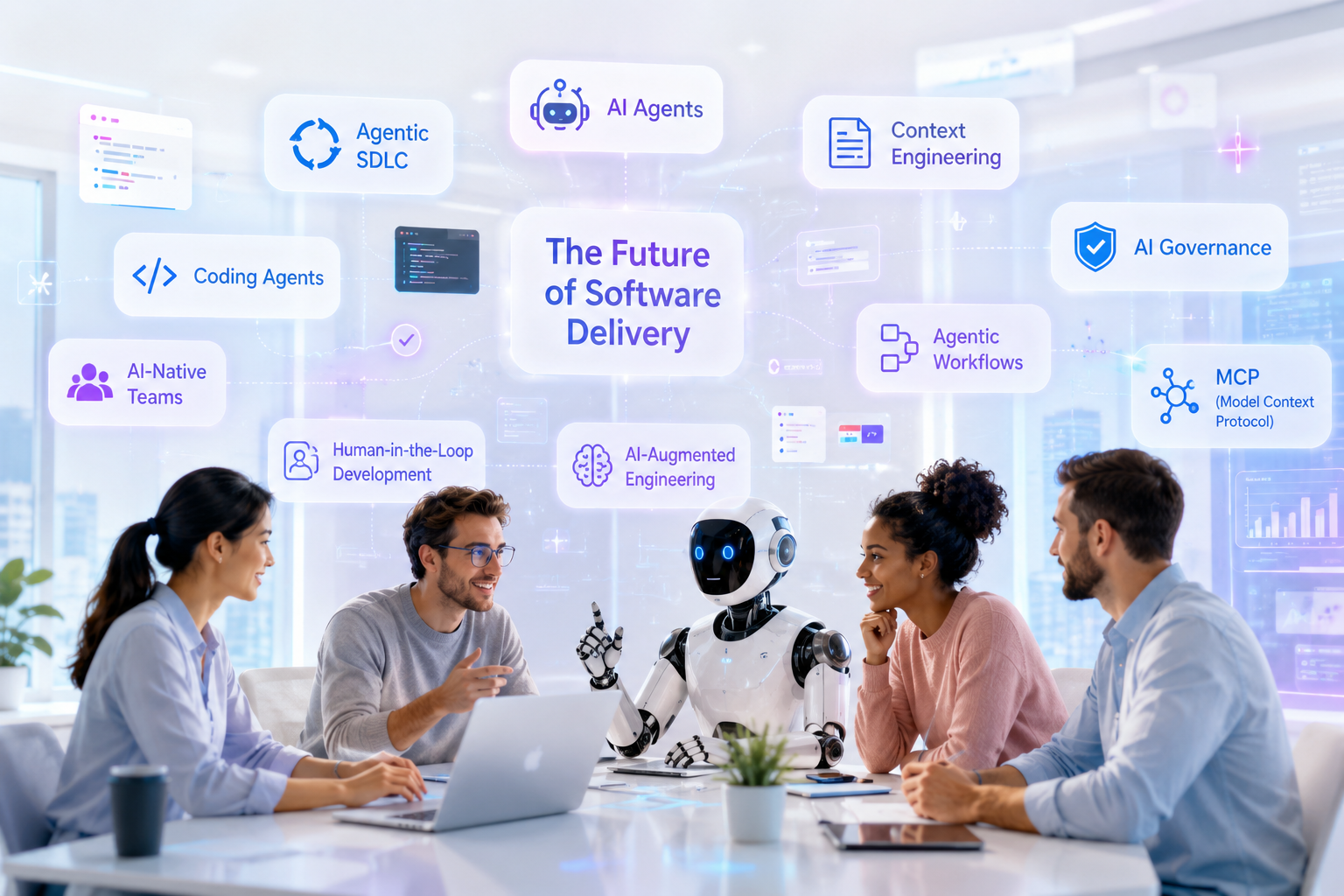
Some terms consistently generate interest among CTOs, VP Engineering leaders, Heads of Delivery, and technology executives. AI-Augmented Engineering. Agentic SDLC. Context Engineering. AI Governance. Developer Experience. AI-Native Teams. Human-in-the-Loop Development. Software Quality in Agentic Development.
These topics attract attention because they focus on outcomes rather than technology. Leaders are not looking for another AI tool. They are looking for better delivery performance. Better software quality. Faster innovation. Greater scalability. Lower risk. The terminology reflects those priorities.
So Where Is All This Going?
One conclusion seems increasingly clear. The most important change is not happening inside the AI models. It is happening inside organizations. The language is evolving because work itself is evolving. Ten years ago, software teams discussed agile transformation. Five years ago, they discussed cloud transformation. Today, they discuss AI transformation.
And just as cloud computing eventually stopped being a special category and became normal infrastructure, AI will likely follow the same path. The most successful organizations will not necessarily be those using the most advanced models. They will be the ones that learn how to integrate AI into team structures, delivery processes, governance frameworks, and business operations. That is why these new terms matter. They are signals, because they reveal where investment is flowing.
They also reveal which skills organizations are building and how software teams are being redesigned. Most importantly, they help us understand where innovation is heading next.
If the vocabulary of an industry is a map of its future, then the AI community is currently drawing an entirely new map.