Enterprise AI, Without the Long Build
There is a slightly awkward moment happening in many companies right now. Management says, “We need AI,” IT says, “We are already testing it.” Someone has ChatGPT Enterprise, another department has built a chatbot, customer service is trying an assistant, HR has a pilot, sales has three different tools nobody quite remembers approving. Congratulations. You have AI, but unfortunately, you may not yet have an AI-enabled business.
The difference is bigger than it sounds. The hard part of enterprise AI is connecting AI to the company’s actual knowledge, systems, processes and people, and then making the whole thing manageable, measurable and trustworthy. That is the problem BizDriver was built to address.
Instead of building the factory, start producing
Imagine deciding that your company needs electric vehicles and concluding that the first sensible step is to build your own battery factory. Technically possible? Certainly. The fastest route to business value? Probably not.
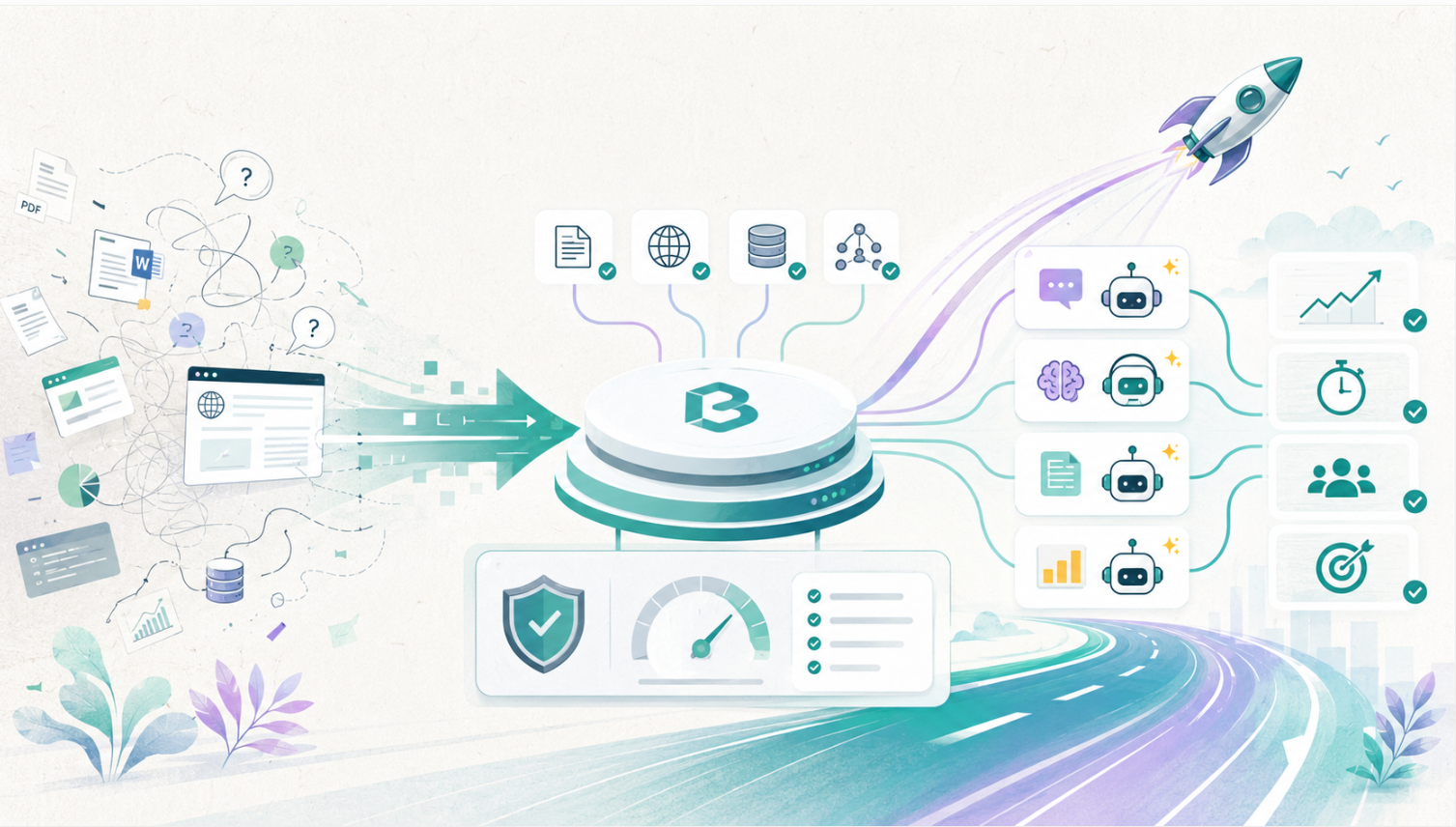
Companies taking the build-from-scratch route with enterprise AI face a similar challenge. Before the useful business applications arrive, someone has to build the underlying architecture: knowledge ingestion, retrieval, agent administration, model configuration, integrations, testing, analytics, monitoring, privacy controls and deployment mechanisms. BizDriver starts from the opposite assumption: What if that foundation already existed?
The platform is designed as an enterprise-grade, multi-tenant AI-agent environment that businesses can acquire, customize and extend instead of spending the next 12–24 months creating the underlying technology themselves. Your engineers can then work on what is actually unique to your company. That is a rather important distinction.
One platform, many AI employees
A useful enterprise AI strategy probably does not involve one enormous chatbot attempting to know everything. The HR team needs one kind of intelligence. Sales needs another. Operations has different workflows. Customer service needs controlled customer-facing answers. IT may need access to completely different knowledge and systems. BizDriver lets businesses configure specialized agents with their own instructions, language, tone, knowledge sources, context rules, forms and actions, while managing them within one environment.
Think less one universal copilot and more a controlled ecosystem of specialized AI services. And those agents do not have to live inside a knowledge-base bubble. Through MCP, APIs and extensible source code, BizDriver provides the foundation for connecting them to CRMs, ERPs, helpdesks, databases, calendars and proprietary systems. They can potentially retrieve information, use tools, trigger actions and bring results back through a natural-language interface. For employees, that can mean less application hopping. For customers, fewer “please contact another department” moments. For management, fewer disconnected AI projects growing in different corners of the organization.
Enterprise AI has an inconvenient characteristic: a confident answer and a correct answer can look remarkably similar. So quality cannot simply be assumed. BizDriver includes automated answer-quality scoring, benchmark testing, review workflows and regression checks. Responses can be evaluated for relevance, clarity and accuracy, while low-performing conversations can be identified for review. There are also controls around data retention, personal-data scrubbing, usage, domains, API keys and secure knowledge storage. In other words, the goal is launch AI and operate it.
The real product BizDriver gives you is time
This may be the most interesting part. Technology teams are perfectly capable of building sophisticated AI infrastructure themselves. The question is whether they should spend their next year or two doing it.
A logistics company might prefer to improve exception handling and customer response. A financial company might want governed access to fragmented internal information. An insurer might want specialized agents supporting claims, underwriting and customer service. BizDriver’s own business examples show precisely those kinds of applications. So the build-versus-acquire decision is about what else they could be building instead.
BizDriver’s proposition is simple: Start with the machinery. Customize the parts that make your business different. Put AI to work. Then keep improving it. Because in enterprise AI, the most expensive technology may be the technology you spend two years rebuilding before the real business transformation can begin.